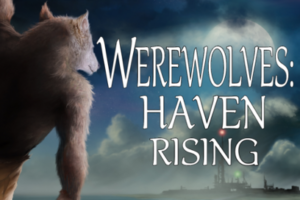
We’re proud to announce that Werewolves: Haven Rising, the latest in our popular “Choice of Games” line of multiple-choice interactive-fiction games, is now available for Steam, Android, and on iOS in the Choice of Games Omnibus app. It’s 33% off until August 2nd!
Rise up, werewolves! Throw off the shackles of a tyrannical military police state. Fight for your pack! Fight for your honor! Fight for your freedom!
“Werewolves: Haven Rising” is a 285,000-word interactive novel by Jeffrey Dean, where your choices control the story. It’s entirely text-based—without graphics or sound effects—and fueled by the vast, unstoppable power of your imagination.
You are one of fifteen pups born in Haven, a government internment camp where werewolves are forced to live and work. Raised in this refuge since birth, you’ve never known the freedom of the wilds. You soon discover the elders have selected you for a mission that will put you directly into the cross-hairs of both the military and werewolf radicals alike!
You’re a new breed of lupine explorer, your hunting grounds an urban jungle of steel and concrete. When your expedition to a forbidden military base goes wrong, a startling discovery sparks an escalation of violence and tragedy that will lead your pack to the hungry maw of war.
• Play as male, female, or nonbinary; gay, straight, or bisexual.
• Rise to power in opposition to a war monger or join him in the fight for werewolf supremacy!
• Train in the path of the warrior, the shadow, or the sage.
• Fight your enemies with claw and fang, or take a non-lethal approach.
• Uncover the true motivations of a powerful anti-werewolf zealot.
• Explore several potential romances, finding love in an increasingly chaotic world.
Once hunted and imprisoned, the werewolves rise again!
We hope you enjoy playing Werewolves: Haven Rising. We encourage you to tell your friends about it, and recommend the game on Facebook, Twitter, Tumblr, and other sites. Don’t forget: our initial download rate determines our ranking on the App Store. The more times you download in the first week, the better our games will rank.
Rise up, werewolves! Throw off the shackles of a tyrannical military police state. Fight for your pack! Fight for your honor! Fight for your freedom! You are one of fifteen pups born in Haven, a government internment camp where werewolves are forced to live and work. Raised in this refuge since birth, you’ve never known the freedom of the wilds. You soon discover the elders have selected you for a mission that will put you directly into the cross-hairs of both the military and werewolf radicals alike! Werewolves: Haven Rising is a 300,000-word interactive novel by Jeffrey Dean. I sat down with Jeffrey to talk about his upcoming game and experiences writing interactive fiction. Werewolves: Haven Rising releases this Thursday, July 26th.
Werewolves: Haven Rising takes place in an alternate timeline where knowledge of werewolf existence became commonplace after an outbreak of violence between two werewolf packs in a small US city. Thousands of innocent humans were killed, sparking a military intervention which all but wiped the werewolf species out. The game itself takes place in the ruins of New Haven, Connecticut, the site of the triumphant final victory of the US army over the retreating werewolf hordes. Walls were erected around the destroyed city and “Haven” became an official refuge for the few hundred werewolves who had abstained from the fighting. They’re kept there, isolated from humanity and watched over by a small military outpost.
These imprisoned werewolves were expected to die out over the following decades, but they proved resilient, making homes for themselves and starting new families. They raised a new generation who have never known freedom—learning, playing, and working within one of the few habitable neighborhoods left within the bounds of their small, decaying urban world. The reader plays the role of a young werewolf born and raised in captivity, coming of age as tensions grow between the wolves and their human captors.
This isn’t your first interactive game rodeo. What drew you to writing interactive fiction?
I grew up reading books from the classic Choose Your Own Adventure and Fighting Fantasy lines and other lesser-known series. Eventually I moved on—most gamebooks were written for a younger demographic—graduating to computer and tabletop roleplaying games. I didn’t return to the interactive fiction fold until 2013, when I discovered the new wave of gamebooks on smartphones and tablets. Unlike the games I’d played as a kid, many of these were written for adults and I was immediately hooked again. It was almost two decades later and it felt like I’d never left the genre.
Soon I was inspired enough to try my hand at gamebook development. I’d been writing short stories and blogging for years, but I’d never dedicated myself to composing a full length novel. My first gamebook, Westward Dystopia, took me a year and a half to write and design. I originally released it for Android after developing a basic engine to handle the branching text and combat dice rolls. The app was fairly well received, and I was encouraged to run a Kickstarter campaign to publish the book as a physical copy. The crowdfunding was successful and allowed me to release not only Westward Dystopia, but two additional gamebooks: Spire Ablaze and The Lords of Benaeron. Around the time I was writing Spire I got addicted to Choice of Games and decided to look into their author program. It took me another year to apply due to my Kickstarter obligations, but once Lords was published and sent out to my backers, I reached out to CoG with a few pitches. Guess which one they liked!
Do you have a favorite Choice of Games game or Hosted Games game?
You always remember your first. Choice of the Deathless grabbed me hard and didn’t let go until I’d played through it at least half a dozen times. I’d be remiss if I didn’t also mention Metahuman, Inc here as well since it’s a very close second favorite.
What were the challenges for you, writing in ChoiceScript?
Honestly? The hardest thing for me was getting used to the house style. I was coming from a gamebook perspective rather than a more nuanced interactive fiction framework, and it took me a while to wrap my head around things like always needing to have at least three choices, intentionality, and all choices being more or less equally viable. In the old Fighting Fantasy books a wrong choice killed you dead. That’s a no-go here, of course.
Technically speaking, I have a background in computer science, so ChoiceScript itself didn’t prove too difficult for me to wrap my head around. I set myself up with Notepad++ and the ChoiceScript syntax highlighting plugin and I was good to go!
Werewolves is just shy of 300,000 words, which is quite an accomplishment. Can you talk a little about your writing process?
Whew, yeah, this thing is a beast in its own right—basically the length of three decent-size novels! My previous gamebook, The Lords of Benaeron, was 180,000 words and in paperback that sucker is fairly thick and dense. I’ve toyed around with the idea of printing out the code for Haven Rising just to flip through a ridiculous number of pages, but thus far I’ve managed to avoid the temptation. Narcissism doesn’t look good on me (or does it?)
Regarding the writing process, the pitch system here at CoG is fairly advanced, necessitating an in-depth outline before the writing starts, so I knew exactly where I was going from day one which is more than I can say about my previous books which always swept me along on the journey. At the risk of giving the standard ‘boring author’ answer here, my process is relatively straightforward: I make sure that I sit down at my laptop every day regardless of how I’m feeling and just write. No excuses. I’m a slow writer—I self-edit as I go, so I only average around 1 to 1.5k words a day—but I end up saving time after the fact by needing fewer revisions than the average author. I also do a lot of my writing in the middle of the night when there’s very little to distract me. There’s nothing quite like writing a werewolf battle scene in the dead of night with a full moon lighting the room.
Short answer, Bernard Pivot-style Questionnaire
Favorite color. Black.
Favorite word. Inveterate.
Profession other than your own you would like to attempt. Musician.
Profession you would never want to attempt. Call center.
Silver Bullet or An American Werewolf in London? An American Werewolf in London.
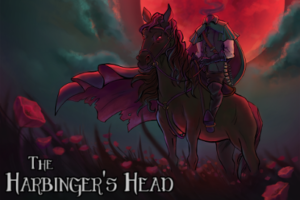
Visit a myth-infested 1820s Ireland. One dark (if not particularly stormy) night, you find yourself face to face with a frightening visage—or lack thereof. Though shaped like a man, the creature you’ve encountered appears to have lost his head. Worse, he seems to think you might be the one to blame! It’s 33% off until July 26th!
The Harbinger’s Head is a fantastic 46,000 word interactive horror novel by Kim Berkley, where your choices control the story. It’s entirely text-based—without graphics or sound effects—and fueled by the vast, unstoppable power of your imagination.
It’s up to you to prove your innocence and discover the true thief of the harbinger’s head before your own winds up on the chopping block!
• Play as male, female, or non-binary.
• Step into the shoes of an herbalist, schoolteacher, or lamplighter.
• Shape your personality and build your skills through the choices you make, or trust your luck at your own peril.
• Make friends—or enemies—of the various Fae creatures you’ll encounter along the way.
• Discover one of eight endings…or meet an untimely death.
Kim Berkley developed this game using ChoiceScript, a simple programming language for writing multiple-choice interactive novels like these. Writing games with ChoiceScript is easy and fun, even for authors with no programming experience. Write your own game and Hosted Games will publish it for you, giving you a share of the revenue your game produces.
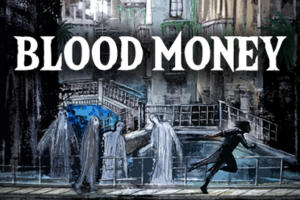
We’re proud to announce that Blood Money, the latest in our popular “Choice of Games” line of multiple-choice interactive-fiction games, is now available for Steam, Android, and on iOS in the Choice of Games Omnibus app. It’s 33% off until July 19th!
By the power of your blood, you and your ghosts will take over your crime family!
Blood Money is a 290,000-word interactive novel by Harris Powell-Smith. It’s entirely text-based, without graphics or sound effects, and fueled by the vast, unstoppable power of your imagination.
When your cousin murders the city’s most notorious crime boss–your mother–a power struggle erupts across the criminal underworld. As your sisters Octavia and Fuschia vie for control, you alone in the family possess the blood magician’s power to summon and command ghosts. They hunger for your blood; if it’s blood they want, then blood they’ll have.
Will you take over the family business? Remain loyal, go it alone, or defect to a rival gang?
• Play as male, female, or non-binary; gay, straight, bi, or ace.
• Embrace your unearthly gifts and build connections with the dead, or banish ghosts to the underworld to protect the living
• Look for love, or manipulate your friends and allies; Betray those who trust you, or maintain family loyalty no matter the cost
• Fight a gang war for your family, defect to your rivals, or reject a life of crime
• Negotiate volatile family relations: resolve squabbles, fall in line as a loyal lieutenant, or sharpen your knife for backstabbing
• Influence citywide politics: exploit the Mayor’s office for your own ends, or use your connections for a greater cause
What will you sacrifice for freedom, and who will you sacrifice for power?
We hope you enjoy playing Blood Money. We encourage you to tell your friends about it, and recommend the game on Facebook, Twitter, Tumblr, and other sites. Don’t forget: our initial download rate determines our ranking on the App Store. The more times you download in the first week, the better our games will rank.
By the power of your blood, you and your ghosts will take over your crime family! When your cousin murders the city’s most notorious crime boss—your mother—a power struggle erupts across the criminal underworld. As your sisters Octavia and Fuschia vie for control, you alone in the family possess the blood magician’s power to summon and command ghosts. They hunger for your blood; if it’s blood they want, then blood they’ll have.
Blood Money is a 275,000-word interactive novel by Harris Powell-Smith. I sat down with Harris to talk blood magic and IF. Blood Money releases this Thursday, July 12th.
Tell me about the world Blood Money is set in and what inspired it.
Blood Money is set in Nasri City, a tropical canal city where ghosts are ever-present, flitting between the living world and the underworld. And that’s where blood magicians come in. Ghosts are drawn to drink magicians’ blood, and unlike ordinary people, blood magicians can summon and communicate with them.
In Nasri City, blood magicians are distrusted at best, despised at worst. Unless you’re wealthy, it’s not an easy place to live: steeped in crime and corruption, there’s a wide divide between decadent aristocracy and the working classes here. You have vast, luscious parkland which is only accessible to certain sections of society, while other districts are run-down and densely populated.
But a crisis point is coming. The merchant classes are growing, rival gangs are working to topple the old crime families, and some blood magicians are building a community of solidarity. Throughout the game, you can influence that tipping point in the direction you choose.
I’ve been interested in ghosts as a theme for a long time, and their blood-drinking was inspired by tales of Odysseus and Aeneas’ journeys to the underworld. The history of Renaissance Italy was an inspiration for the family squabbles and the weight of ancestry, and of course all those Venetian canals. Visuals also played a big part for me: noir imagery of dark cityscapes in the driving rain, images of Sao Joao Batista Cemetery in Rio de Janeiro, the creepy faceless sculptures by Kevin Francis Gray…mixed together, it all combined to make a dark fantasy setting that I’m very proud of.
What brought you to writing interactive fiction?
As teenagers, my now-wife and I created mods for the videogame Baldur’s Gate II, which sharpened coding and design skills for both of us. Along with the interactive books like Fabled Lands that I read as a child, and tabletop roleplaying, that taught me about branching narratives. Then, when I came across Twine many years later, I started making games of my own. I released several interactive short stories about fraught relationships (one of my favourite game topics) and got involved with the interactive fiction community.It was great to make the games I wanted to play, but I didn’t consider making money from it until sub-Q Magazine approached me about reprinting one of my games. I published more games with them, and then, as I’d enjoyed the company’s work for a long time, I got in touch with Choice of Games. The rest is history!
What was the most challenging part about creating the game for you?
I love working with ChoiceScript itself, but for this game the planning was hard work. I had never outlined such a big interactive project, and so increasing the scale, widening the variety of end states, making the plot satisfyingly branchy while making sure the pacing works…it was a challenge! But the guidance through the outlining process made for a much stronger game, and because a lot of that effort was front-loaded, it made the actual game far more straightforward to develop.
What are you working on next?
At the end of the month, I’m teaching at the Infinite Journeys Interactive Fiction Summer School at the British Library. In the longer term, I’m working on a second game for Choice of Games about attending an exclusive finishing school in order to regain your family’s fortunes through marriage, getting into university, or otherwise distinguishing yourself. There are etiquette classes, ballroom dances, rival cliques, and dark secrets bubbling away beneath the surface. And plenty of potential backstabbing—though not as literally as in Blood Money. In this game you take your enemies down with propriety.
Short Answer, Bernard Pivot-style:
Favorite color?
Green.
Favorite word?
Tropical.
Profession other than your own you would like to try.
Academic in the humanities area.
Profession you would never like to try. Dancer.
Venice or Amsterdam?
Amsterdam—we’re going through a heatwave in the UK so the idea of being in Venice makes me want a lie down!
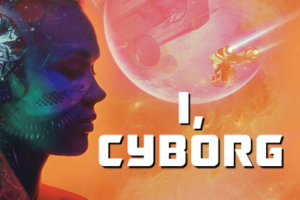
We’re proud to announce that I, Cyborg, the latest in our popular “Choice of Games” line of multiple-choice interactive-fiction games, is now available for Steam, Android, and on iOS in the Choice of Games Omnibus app. It’s 33% off until July 5th!
Outfly, outshoot, and outwit your enemies as an outlaw cyborg on the run! You’re a cyborg copy of Ypsilanti Rowe, the interstellar outlaw, whose enemies (and exes) are gunning for you. Can you upgrade your brain and pull one last heist?
I, Cyborg is a 300,000-word interactive science-fiction novel by Tracy Canfield. It’s entirely text-based, without graphics or sound effects, and fueled by the vast, unstoppable power of your imagination.
Being a cyborg copy of the famous outlaw Ypsilanti Rowe comes with plenty of advantages. But when your cybernetic brain begins to fail only a rare and obsolete part can make your systems function again. Journey across the galaxy as you hunt down the missing piece. Along the way you’ll shoot down enemy ships, or jam their sensors so they never know you’re there; seduce Ypsilanti’s old flames—or just stay out of their gunsights; dogfight beneath high-gravity stormclouds and race pirates through a mined-out asteroid’s rocky tunnels.
When Ypsilanti turns up in the original flesh, will the two of you make the perfect team? Or is there only room in this galaxy for one of you?
• Play as male or female; gay, straight, bisexual, or asexual.
• Boost your skills with cybernetic upgrades: you’re a cyborg!
• Ambush a weapons shipment above a gas giant’s rings.
• Smuggle alien pets, penetrate the walls of a comet prison, and befriend an intelligent starship.
• Work for the local crime lords, set them at each others’ throats, or rat them out to the Intersolar Police.
• Infiltrate the halls of power and steal top-secret data with a touch of your augmented fingertips.
• Choose to favor your human instincts, your custom software, or a balance between the two.
We hope you enjoy playing I, Cyborg. We encourage you to tell your friends about it, and recommend the game on Facebook, Twitter, Tumblr, and other sites. Don’t forget: our initial download rate determines our ranking on the App Store. The more times you download in the first week, the better our games will rank.
Picking up where you left off, you will encounter new challenges and face tough decisions in the hope to finally escape the living nightmare in the districts that only became worse. Decide whom you will trust, and how will you achieve your goal. It’s kill or be killed. It’s 33% off until July 3rd!
Doomsday on Demand 2 is a 135,000 word interactive novel by Norbert M., where your choices control the story. It’s entirely text-based—without graphics or sound effects—and fueled by the vast, unstoppable power of your imagination.
• Face deadly enemies varying from mutants to humans.
• Decide who you’ll trust. Strengthen your friendship, or make enemies.
• Uncover the secrets the destroyed world has to offer while surviving in the districts.
• Choose your own personality and end pursue your goal to finally end the living nightmare.
Norbert M. developed this game using ChoiceScript, a simple programming language for writing multiple-choice interactive novels like these. Writing games with ChoiceScript is easy and fun, even for authors with no programming experience. Write your own game and Hosted Games will publish it for you, giving you a share of the revenue your game produces.
Being a cyborg copy of the famous outlaw Ypsilanti Rowe comes with plenty of advantages. But when your cybernetic brain begins to fail only a rare and obsolete part can make your systems function again. Journey across the galaxy as you hunt down the missing piece. I, Cyborg is a 300,000-word interactive science-fiction novel by Tracy Canfield, releasing next Thursday, June 28th. You can play the first three chapters now for free!
I, Cyborg is one of the few “purely” science-fiction games I think we’ve put out. Can you say a little about what the genre means to you? Favorite novels, comics, or films?
When I was in second grade my dad picked out a book for me at the library and said “I think you’ll like this.” The book was I, Robot, by Isaac Asimov, and he was right! I’ve been reading science fiction ever since. (And watching it, too—I saved up my allowance in a candy box so I could buy a Millennium Falcon model kit, which I suppose answers the “favorite films” part of the question!) For me, science fiction is about asking “What if things were different?” and SF writers will never, ever run out of interesting answers.
I still read a lot of science fiction, but there are several books I’ve reread over and over: Robert Heinlein’s The Moon is a Harsh Mistress, with its unbeatable mix of high-tech engineering and high-stakes politics as the inhabitants of a lunar colony fight for their rights; Iain Banks’s Player of Games and John Varley’s The Ophiuchi Hotline, both of which deal in very different ways with the problems people still have once they’ve achieved utopia; Octavia Butler’s Xenogenesis trilogy, about the Oankali—some of the most believably alien aliens in science fiction—making contact with humans, contact that will change both species forever; and Philip K. Dick’s Ubik, in which a team of psychic security experts realize reality is crumbling around them. And in comics, Andrew Hussie’s Homestuck has an enormous cast of endlessly quotable characters in a time-travel story where the fate of universes—plural—is at stake.
What inspired this story in particular?
I’d actually written a novelette in this same setting before I pitched I, Cyborg to Choice of Games! It’s called “Salvage”, and eventually appeared in the online magazine Giganotosaurus.
“Salvage” had an almost abstract inspiration—I started with the structure I wanted to use for the story, the points at which the subplots would interweave and combine, and then asked “What’s a plot that would fit this structure?” And because that structure kept coming back to key similarities and differences between two characters, the next question was “Who are these characters, and what’s their relationship to each other?”
For me, any story where you see two versions of the same character—whether they’re clones, or come from alternate timelines, or are just good old-fashioned twins—is a very pure version of that central SF question: what if things were different? I settled on the idea of making one character a human being and the other a cyborg with a copy of their mind. The two of them have been living their own lives for years, but now they’re going to end up confronting each other again.
So then, of course, I had to decide what all the rest of the plot was, and I thought of Brian Daley’s space opera novels. I didn’t want to imitate Daley—imitating another writer is playing to tie, when you ought to be playing to win. Instead, I wanted do my own version of everything I loved about Daley: the adventure, the light-heartedness, the wit.
I went with making one character a classic space opera character—an overconfident outlaw pilot—and the other a cyborg with a copy of the first character’s mind. Which is the same place the game starts from! The big difference is that the novella tells one specific story, and the game lets the player decide just who these two people are and what their relationship to each other ultimately is.
What do you think about the looming robotic takeover? I, for one, welcome our new AI overlords.
Since the prehistoric era, every human society has offered its members the same deal: either do something other people value enough that you can make a living, or find someone who’ll provide for you.
But as more and more of the jobs that used to be done by humans are performed by robots and computers – and not just manufacturing jobs; IBM’s Watson has been used for legal research—we’ll reach a point where most humans’ labor will have no value. And when that happens, what kind of society do we want to live in? Will we make sure everyone has a basic standard of living? Will we require people without skills to do pointless makework in return for food and shelter? Will the robots’ owners control all the wealth, even as the cost of necessities goes down?
It’s easy to say “there’ll always be enough fulfilling jobs to go around” without explaining how we’ll come up with seven, eight, or nine billion of them. And what happens if we can’t?
What brought you to the world of interactive fiction?
In middle school my dad gave me a book on the BASIC programming language, and my first thought was to write little games with it. Years later I bought a set of the classic Infocom text adventures on eBay—their Hitchhiker’s Guide to the Galaxy was actually written by Douglas Adams himself. (The eBayer who sold me the games turned out to be a former Infocom employee, too.)
What did you find most challenging about the design and coding of I, Cyborg?
The ChoiceScript language I, Cyborg is written in was developed to allow writers with no programming experience to create text-based games: it’s deliberately simple and straightforward. But since I’d done plenty of programming in other languages (my PhD is in computational linguistics), I sometimes found myself pushing ChoiceScript’s limits.
For example, in Chapter 8 of I, Cyborg, each of the five starships competing in the Galdra Airshow has its own Aerobatics and Gunnery score. We have to rank them from first to fifth based on their total scores—and a ship that doesn’t finish because it’s been disqualified or eliminated has to be at the bottom of the ranking regardless of how many points it’s earned. In many programming languages that would take a line or two of code; in ChoiceScript it’s over a hundred and fifty. (And there’s no step-through debugger!)
Actually writing the story is very different, too. In a book, an author always knows what’s happened so far and what will happen next—so while you’re surprising the reader, you can also make every event build on or develop from what came before. In I, Cyborg, the challenge was to make the story feel like it had a beginning, a middle and an end, with increasing tension as you reach the climax, even as control of what the main character actually does is turned over to the reader.
What are you working on next?
I have a novel that’s on submission to several editors—it’s called Good Girls Want Villains, and it’s about a woman who’s been flirting with a supervillain and decides to get a costume and pull off a heist of her own, and soon finds herself in even more trouble than she expected (and she expected a lot). In the meantime I’m finishing another novel, Maneki Neko, that expands on a novelette (“i know my own & my own know me”) that originally ran in Analog.
Play through Pride and Prejudice, the classic romance novel! You are a young woman in 1813, hoping to find your true love. But which of your five suitors will you favor? The aloof nobleman Mr. Darcy? The amiable Mr. Bingley? The stuffy Mr. Collins, the kind-hearted Colonel Fitzwilliam, or the villainous Mr. Wickham? It’s 33% off until June 14th!
The Courting of Miss Bennet is a 200,000 word interactive romance novel by Michael Gray, where your choices control the story. It’s entirely text-based—without graphics or sound effects—and fueled by the vast, unstoppable power of your imagination.
• Find love in the Regency era!
• Play through the classic novel!
• Choose from five different bachelors!
• Experience courting in 1800’s England!
Find your happy ending today!
Michael Gray developed this game using ChoiceScript, a simple programming language for writing multiple-choice interactive novels like these. Writing games with ChoiceScript is easy and fun, even for authors with no programming experience. Write your own game and Hosted Games will publish it for you, giving you a share of the revenue your game produces.
Battle the amok mummy of a disreputable love potion huckster while filming the story of the century! There is a news story here bigger than any antiques show. How will you cover it without getting killed and to what lengths will you go to bring home the story of the century? It’s 33% off until June 8th!
A Mummy Is Not An Antique is a 52,000 word interactive novel by Randy Condon, where your choices control the story. It’s entirely text-based—without graphics or sound effects—and fueled by the vast, unstoppable power of your imagination.
You play as the producer of a PBS antiques appraisal show, dutifully starting another on-site episode while managing the eccentric personalities of your cast and crew. Events go pear-shaped when a guest arrives with a mummified human body, allegedly the corpse of the local legendary Bog Mummy. Quickly a menagerie of forest shamans, a priest, show-security, a southern gentleman and his supposed grandchildren squabble with increasing fervor over ownership of the body.
• Play as male, female, or non-binary.
• Enjoy a comedy-horror adventure battling (and filming) the supernatural.
• Trade quips with the mummy of Professor Thadeus Frost, salesman extraordinaire of love potion and other dubious concoctions.
• Discover the secrets of the mysterious scroll behind all these shenanigans.
• Risk you and your crew’s life and limb to get the story. But how far is too far? You decide.
• Five different endings available, depending upon your choices.
Randy Condon developed this game using ChoiceScript, a simple programming language for writing multiple-choice interactive novels like these. Writing games with ChoiceScript is easy and fun, even for authors with no programming experience. Write your own game and Hosted Games will publish it for you, giving you a share of the revenue your game produces.

 Steam
Steam Twitter
 Facebook
 Tumblr
 RSS Feed